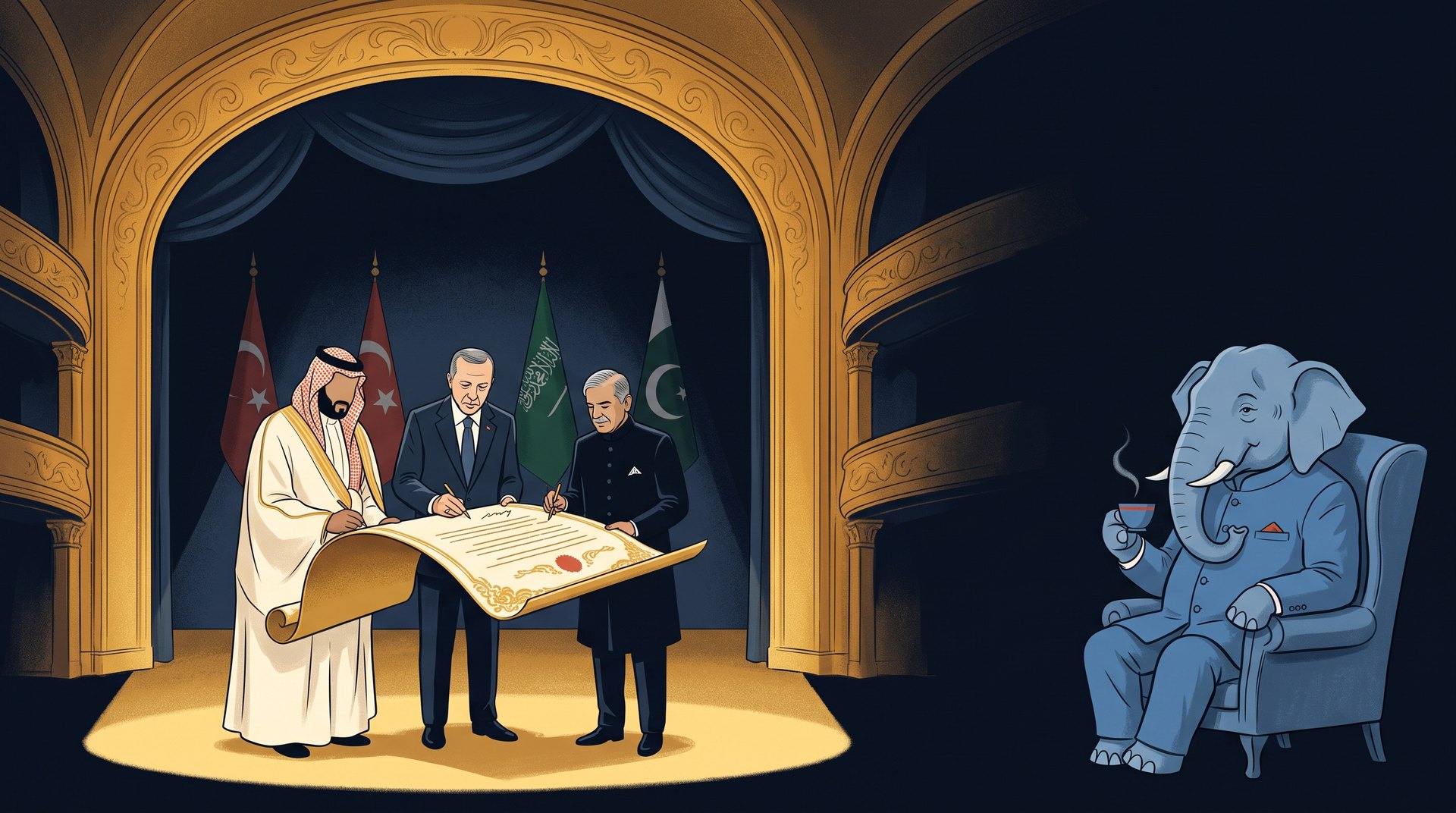
The image is the message. On 7 August 2026, in Islam's holiest city, three men stood shoulder to shoulder and signed a single promise: that an attack on one of them would be an attack on all three. Saudi Crown Prince Mohammed bin Salman, Turkish President Recep Tayyip Erdogan and Pakistan's Prime Minister Shehbaz Sharif had just conjured what headline writers instantly called an "Islamic NATO." It is a sentence that has held the real NATO together for seventy-five years. The question that should keep New Delhi up at night is a quieter one: does it mean anything here, and if so, to whom?
We came to this with no verdict to defend, only the reporting and the single primary document available, and we will follow them wherever they lead. Where they lead is somewhere more interesting than the slogan. This is a pact far louder on paper than it is likely to be in practice, signed by three governments whose interests overlap but do not merge, at a moment when the American umbrella that sheltered the Gulf for generations has started to leak. And for India, the paper is almost the least of it. What matters is the machine it might switch on: a richer, better-armed Pakistan, wearing a bloc's colours, sitting astride the western edge of India's world.
The pact, in plain terms
Strip away the summitry and the deal is almost startlingly short. Three governments have said they will treat an attack on one as an attack on all, and that they will deepen cooperation across "all aspects" of defence. That is nearly the whole of it. It grows out of a narrower Saudi-Pakistan mutual-defence pact signed in September 2025, and it folds in Turkey, a NATO member fielding the alliance's second-largest army. The timing is not subtle. It landed in the wreckage of the summer's US-Israeli war on Iran, with the Strait of Hormuz half-throttled and every Gulf capital asking the same question aloud: if Washington will not always come, who will?
All three insist the pact is "purely defensive," open to new members, and no threat to anyone's existing alliances. As Al Jazeera's Priyanka Shankar reported, the language was draped in "brotherhood and Islamic solidarity." The venue and the vocabulary are why the "Islamic NATO" tag stuck on contact. That tag is doing an enormous amount of work, and almost all of it is misleading.
The document itself: what is written, what is real
Start with an uncomfortable fact that most coverage skates past. Nobody outside the three governments has seen the actual agreement. The full text is unpublished. What sits in the open is a joint statement and Pakistan's foreign-ministry press release, and they carry the headline vow and little else. As The Economic Times put it, the statement "did not give specifics on the commitments or obligations each had." No triggers. No command structure. No promise of forces. No mention, anywhere, of nuclear weapons. To read this pact honestly is to judge a sealed envelope by its handwriting on the outside.
Read that way, the distance between what the pact says and what it can plausibly do is a canyon. The words are lifted straight from NATO's Article 5. But Article 5 is not a sentence; it is an integrated military command, permanent bases, joint war plans and three-quarters of a century of drilled habit standing behind the sentence. Behind the Makkah clause, so far, stands a communique. Özgür Ünlühisarçıklı of the German Marshall Fund said as much to Al Jazeera: this is "a framework for closer strategic, military, and defence-industrial coordination," not "a mutual defence pact that can be compared to NATO." The Warsaw-based OSW Centre for Eastern Studies filed the same verdict in three words: "a loose alliance."
The clearest way to see the gap is to lay the promise beside the practice, line by line.
| The promise | On paper | In practice | |
|---|---|---|---|
| "Attack on one, attack on all" | A NATO-style collective-defence clause, front and centre. | No published obligations. Very unlikely to drag Saudi Arabia or Turkey into a war they did not pick, an India-Pakistan clash above all. | signal |
| Commitments & command | Absent from the public text. | Nothing specified. No joint command, no bases, no force pledges disclosed. | missing |
| A nuclear umbrella | The statement never mentions nuclear weapons. | Implied through Pakistan, the only nuclear-armed signatory. Never stated, never confirmed. | implied |
| A named enemy | None. Officials stress it "does not target any country, including Iran." | Reads in Tehran, Tel Aviv and Delhi alike as a signal, whatever the text says. | deniable |
| A track record | Arab collective-defence pacts have a long history. | By one count in the reporting, they have produced joint action in only about a fifth of cases. | weak |
Does it have real meat?
Our reading is blunt: the pact is real as a signal and thin as a treaty. That is not the same as nothing. Turkey is a genuine defence-industrial power, Saudi Arabia a genuine financial one, and a standing arrangement to braid their arms industries, training and money into Pakistan's large, combat-worn military is a real shift, even if not a single shot is ever fired under the clause. The substance you can actually touch is industrial, not battlefield: drones, missiles, joint production and financing, the things that move in peacetime and quietly change the balance in the next war.
Some read it as far bigger than its clauses. The Council on Foreign Relations went furthest, arguing in a headline that is also its thesis that the American-led Middle East order is over and the Mecca agreement proves it. We would put it the other way round: the pact is less the cause of that shift than its receipt, a signature on a change the summer's war on Iran had already forced.
And then there is the slide that impresses at a summit and dissolves on inspection: the combined order of battle. Put the three together and the numbers loom. Put India beside them, alone, and the loom shrinks. This is where the "Islamic NATO threatens India" story meets the data, and the data does not cooperate.
| Metric | Saudi | Turkey | Pakistan | Combined | India |
|---|---|---|---|---|---|
| Active troops | 247,000 | 481,000 | 660,000 | 1,388,000 | 1,455,550 |
| Total aircraft | 917 | 1,101 | 1,397 | 3,415 | 2,296 |
| Tanks | 1,085 | 2,284 | 2,677 | 6,046 | 4,614 |
| Aircraft carriers | 0 | 1* | 0 | 1* | 2 |
| Warships | 32 | 192 | 121 | 345 | 295 |
| Submarines | 0 | 13 | 8 | 21 | 18 |
| Nuclear warheads | 0 | 0 | 170 | 170 | 180 |
| Defence budget | $63.9B | $51.4B | $9.1B | $124B | $75B |
Read the table slowly, because it quietly disarms the scariest version of this story. India, on its own, fields more active troops than all three signatories put together. It holds more nuclear warheads than Pakistan, the only member of the bloc that has any. It very nearly matches the trio's combined submarine fleet. Where the three lead, on aircraft, tanks and budget, they lead as three separate forces that have never fought as one and, on the evidence of every Arab defence pact before this, probably never will. The bloc is heavier than India on a spreadsheet. It is not heavier than India in a war India actually has to fight.
There is a subtler story in the fine print, and it is the pact's real logic. Three of the four militaries in that table lean heavily on imported weapons: SIPRI's latest survey of the global arms trade ranks Saudi Arabia, Pakistan and India among the world's five largest arms importers. Turkey is the exception, and the tell. It has become a genuine producer and exporter, its Bayraktar drones and the TCG Anadolu drone carrier giving it hardware the others must buy. Read that way, the division of labour is plain: Turkey brings the industry, Saudi Arabia the money, Pakistan the manpower and the group's only nuclear weapons. That is a coalition of complementary needs, a real basis for cooperation, and a very different animal from a war-fighting alliance.
Why India should care anyway
So if the treaty is thin, the combined army a mirage and India un-named, why should Delhi feel anything at all? Because the pact's real effects reach India by two routes that have nothing to do with its collective-defence clause. One runs through Pakistan. The other runs through India's own wallet.
Take Pakistan first. The danger is not that Riyadh has enlisted in an anti-India front; it has too much riding on India to bother. As the analysts at StratNews Global put it in a piece titled simply "Should India Worry?", the agreement names no enemy and Saudi Arabia will not trade its Indian stake for Pakistan's quarrels. The sharper worry is what the pact hands Islamabad: Saudi money for a chronically bankrupt economy, a door to Turkish drones and defence technology, and the prestige of sheltering, at least in rhetoric, under a wider umbrella. A Pakistan with fuller pockets and better kit is a harder neighbour whether or not a single Saudi soldier ever moves. The Lowy Institute caught the asymmetry perfectly: Pakistan reads the pact as deterrence; India reads it as one more variable to manage.
India's own strategists are split on how loudly to worry, and the split is instructive. Hindustan Times' executive editor Shishir Gupta framed the whole question as whether this is a new Sunni bloc or a strategic tool against India. The Delhi think tank Observer Research Foundation was cooler, reading Pakistan's celebrations as "premature vainglory" that oversells what Islamabad actually banked. Both can be true at once. A pact can be hollow on obligations and still be a useful prop for a country that badly needs one.
The nuclear question is where the fear pools, and where discipline matters most. The agreement says nothing about nuclear weapons. But Pakistan is its only nuclear-armed member, and analysts writing for Middle East Eye were explicit that what Pakistan "brings" includes its "nuclear armament and strategic depth." Whether that quietly extends a Pakistani umbrella over Riyadh is unproven and, for now, unprovable. It is a possibility Delhi must price in, not a fact it can act on, and it is worth remembering, per the SIPRI figures above, that India already out-numbers Pakistan warhead for warhead.
The second route is the one an ordinary Indian would feel first, long before any soldier. India is not a spectator to Gulf security; it is one of the most exposed large economies on the planet. Nine million Indians live and work in the Gulf. They send home the single biggest stream of money India receives from abroad. India's trade with the Gulf runs past 170 billion dollars a year, and a hard slice of the oil that moves its economy sails through the very waters the Makkah signatories now claim to guard. A bloc that shapes the security of the Gulf shapes the security of all of that, whether it ever says the word "India" or not.
The web beneath the handshake
The tidy image of a unified Islamic bloc falls apart the instant you look at the region it claims to organise. The Middle East is not a team. It is a knot of rivalries that no single summit can untie, and several of the strands run straight through the pact itself.
The deepest fault line is the one the signatories most want to paper over. Saudi Arabia is the Sunni world's leading power; Iran is the Shia world's, and the two have spent a generation fighting through proxies from Yemen to Syria. Officials in Riyadh, Ankara and Islamabad all insist the pact "does not target Iran," and there is a real case, made by the historian Juan Cole at Informed Comment, that it is aimed less at Tehran than at hedging against an unreliable Washington and an emboldened Israel. But a Sunni-led defence bloc on its border is read in Tehran through the Sunni-Shia lens no matter what the communique says, and that reading shapes how Iran treats all three.
The awkwardness runs inside the bloc too. Turkey and Saudi Arabia are both Sunni powers and also old rivals, one still carrying the memory of the Ottoman caliphate, the other the guardian of Mecca and Medina; theirs is a marriage of convenience under pressure, not a natural alliance. Egypt, the Arab world's most populous state, was courted openly, its foreign counterpart calling it a "natural partner," and it has held back, wary of obligations that could pull it into fights that are not its own. And over all of it hangs Israel, which, as Al Jazeera's Simon Speakman Cordall reported, is weighing what the pact means for its own security in the raw aftermath of the Iran war.
Who else might join?
Erdogan says the pact is built to grow, and the reporting points to a next tier rather than a rush. Qatar, badly rattled during the summer's strikes around the Gulf, is described as the most natural next member; Kuwait, close to all three founders, is said to be shopping for extra insurance; and analysts float Azerbaijan, Syria and Jordan as states that could sign relatively fast. Egypt is the tell. Courted hardest, it has stayed out, guarding its own peace-treaty commitments and its freedom to choose its own fights.
But a wider guest list would not settle the question that matters. A pact that keeps adding signatures without adding a command, bases or binding force pledges grows broader without ever growing deeper. The more states that sign a promise no one has defined, the more the promise drifts from a machine of deterrence toward a statement of mood. That is the paradox sitting at the centre of the Makkah agreement, and it is exactly why India can afford to watch it without flinching, and cannot afford to ignore it.
India's move, and the trap to avoid
India's first instinct has been to turn the temperature down, and it was the right one. When a report claimed Delhi had approached Israel about a counter-pact, the Ministry of External Affairs killed it flatly as "fake news," a denial reported by Hindustan Times' Shubham Pandey. That is not timidity; it is strategy. The fastest way to turn a hollow pact into a real anti-India alliance is to treat it as one. Rush to build a rival bloc with Israel, and India would hand the Makkah signatories the enemy their communique conspicuously lacks, and give a thin document a purpose it does not yet have.
Beneath the calm, India's menu is narrow but real, and it plays to a strength Delhi has spent decades honing: managing rivals who are also partners. India's ties to the Gulf are, in most respects, warmer than Pakistan's, and Riyadh and Abu Dhabi are actively courting Indian investment, energy and technology; the smart play is to deepen those bilateral bonds until no bloc has an interest in leaning India's way. It can lean on the groupings it already sits in, from its partnership with Washington to the I2U2 arrangement with Israel, the UAE and the United States. It can keep its own hedge alive through Iran, where the Chabahar port gives it a stake in a rival of the pact's members. And it can do the unglamorous, essential work of protecting the nine million citizens and the remittance lifeline that make the Gulf a domestic Indian interest, not merely a foreign one.
The larger truth, argued well in The Hindu, is that the Makkah agreement is one more marker of a world where middle powers hedge instead of choosing a camp. India has been practising that art for years, balancing Washington against Moscow, Tehran against Riyadh, Jerusalem against Ramallah, and rarely dropping a plate. This pact does not overturn that act. It only raises the cost of a stumble. Our judgment is that the document signed in Mecca will matter less for anything its collective-defence clause ever triggers than for the quieter thing it marks: the Gulf raising its own scaffolding for a post-American age, and Pakistan finding a new set of shoulders to stand on. India's task is not to counter a treaty. It is to make sure that scaffolding is never built against it, and the surest way to fail at that is to panic loudly enough to make it worth building.
The correspondents
The reporting behind this piece spans newsrooms and think tanks across three continents. These are the correspondents and desks whose work we drew on. Contacts are their own X handles where available, otherwise a professional profile or the outlet.
| Correspondent | Publication | Contact | Focus |
|---|---|---|---|
| Priyanka Shankar | Al Jazeera | @priyankashank17 | What's in the pact |
| Abid Hussain | Al Jazeera | @abidhussayn | A shield or a signal |
| Simon Speakman Cordall | Al Jazeera | @IgnitionUK | Israel's calculus |
| Abubakr Al-Shamahi | Al Jazeera | @ShamahiAbubakr | A new regional order |
| Nawaf Obaid | Al Jazeera (opinion) | @NawafEObaid | Post-American Middle East |
| Shishir Gupta | Hindustan Times | profile ↗ | Sunni bloc or tool vs India |
| Shubham Pandey | Hindustan Times | — | India's MEA response |
| Juan Cole | Informed Comment | @jricole | Not about Iran |
| StratNews Global desk | StratNews Global | stratnewsglobal.com ↗ | Should India worry? |
| The Interpreter | Lowy Institute | @LowyInstitute | New Delhi's calculus |
| Expert Speak | Observer Research Foundation | @orfonline | "Premature vainglory" |
| Editorial | Council on Foreign Relations | @CFR_org | End of the US order |
| Op-ed desk | The Hindu | @the_hindu | Strategic hedging |
| VIF desk | Vivekananda Int'l Foundation | @vifindia | Shifting geopolitics |
| Dialogues | Georgetown Journal of Int'l Affairs | gjia.georgetown.edu ↗ | US force posture |
| Editorial | Morocco World News | moroccoworldnews.com ↗ | Multipolar order |
Sources
Every load-bearing claim, linked to its origin. The primary document is the public joint statement; the full treaty text is unpublished. Where our record carried no author byline, the outlet is credited and linked.
- Al Jazeera, Priyanka Shankar, "Turkiye, Saudi Arabia, Pakistan sign joint defence agreement: What's in it?" aljazeera.com
- The Hindu, "Pakistan, Saudi and Turkiye sign joint defence agreement" thehindu.com
- The Economic Times, "Saudi Arabia, Turkey and Pakistan sign joint defence deal amid regional turmoil" economictimes.com
- Al Jazeera, "What are Saudi Arabia, Turkiye and Pakistan's joint military capabilities?" aljazeera.com
- Al Jazeera, "Which other countries could join the Turkiye-Saudi-Pakistan defence pact?" aljazeera.com
- StratNews Global, "Mecca Pact: Should India Worry?" stratnewsglobal.com
- Lowy Institute (The Interpreter), "New Delhi's Mecca Pact calculus" lowyinstitute.org
- Council on Foreign Relations, "The U.S.-Led Middle East Order Is Over. The Mecca Agreement Proves It" cfr.org
- Observer Research Foundation, "The Middle East Muddle: Pakistan's Premature Vainglory" orfonline.org
- Middle East Eye, "Mecca agreement: Why Saudi Arabia, Turkey and Pakistan teamed up" middleeasteye.net
- Informed Comment, Juan Cole, "The Mecca Security Pact is not about Iran" juancole.com
- Al Jazeera, Simon Speakman Cordall, "Israel mulls Saudi, Turkiye, Pakistan pact as elections loom" aljazeera.com
- Hindustan Times, Shubham Pandey, "MEA rejects report India approached Israel for pact" hindustantimes.com
- Hindustan Times, Shishir Gupta, "The Mecca defence pact: a new Sunni bloc or a strategic tool against India" hindustantimes.com
- The Hindu (opinion), "The Mecca Pact and the rise of strategic hedging" thehindu.com
- Vivekananda International Foundation, "Beyond Oil & Allies: Saudi-Pakistan Defence Pact and Shifting Geopolitics" vifindia.org
- Georgetown Journal of International Affairs, "The Saudi-Pakistani Defense Pact and U.S. Force Posture in the Gulf" gjia.georgetown.edu
- Morocco World News, "The Mecca Defense Agreement: Towards a Multipolar Security Order" moroccoworldnews.com
- Global Firepower 2026 and IISS (force and aircraft data, via Al Jazeera) globalfirepower.com; SIPRI Yearbook 2025 (nuclear warheads) sipri.org; SIPRI, Trends in International Arms Transfers 2024 (import rankings) sipri.org; USNI News and Naval News (aircraft carriers); Embassy of India, Riyadh and Arab News (Gulf exposure).
Common questions
A defence agreement signed on 7 August 2026 by Saudi Arabia, Turkey and Pakistan in Mecca, under which an armed attack on any one is to be treated as an attack on all three. It builds on a 2025 Saudi-Pakistan pact and adds Turkey.
No. Only a joint statement and press release are public. They carry the collective-defence promise but disclose no obligations, command structure, triggers or nuclear terms. The full treaty text is unpublished.
Not in substance. It borrows NATO's language but, on the evidence so far, has none of NATO's command, bases or binding commitments. Analysts describe it as a framework for coordination and "a loose alliance," not a NATO-style pact.
Not directly, and it names no target. Its effect on India runs through Pakistan, which gains financing, technology and prestige, and through India's large economic exposure to the Gulf. Would Saudi Arabia join an India-Pakistan war? Almost certainly not. India alone also out-numbers the three signatories combined in troops and holds more nuclear warheads than Pakistan.
India's government has dismissed reports that it approached Israel as "fake news," and there is logic in that restraint. Treating a thin pact as a real anti-India alliance risks making it one. India's stronger card is to deepen its own Gulf ties and keep managing competing interests, an art it has long practised.
Ninety seconds. Five mornings a week. Forty tabs, replaced.
The GeoMemo Daily Brief is independent geopolitical intelligence for the people who make the decisions, diplomats, investors, strategists and journalists on deadline. Curated under ICD 203 analytic tradecraft and read across more than 5,000 publications worldwide, it hands you the whole picture rather than one side of it. In your inbox by 08:30, and gone in ninety seconds.
Subscribe free →